The global electric vehicle (EV) battery manufacturing industry is growing fast. This growth is due to more people wanting green transportation and government support for EVs. In 2023, the EV battery market was worth USD 59.06 billion. It’s expected to reach USD 111.20 billion by 2032, growing at 6.4% each year.
Big names like CATL, LG Chem, and Panasonic are spending a lot on lithium-ion battery production and expanding their factories. They’re working on new battery types and materials to make EVs better and cheaper.
The EV battery supply chain is very important. Right now, China makes most of the key parts like cathodes and anodes. But, there’s a push to spread out production and make it greener. This is to cut down on reliance on one country and lessen the environmental harm of making batteries.
Key Takeaways
- The global EV battery market is projected to reach USD 111.20 billion by 2032, with a CAGR of 6.4%.
- Lithium-ion batteries currently dominate the market, but innovations in battery chemistry are expected to drive growth.
- China holds a significant share in the EV battery supply chain, prompting efforts to diversify production and sourcing.
- Sustainable manufacturing practices and recycling initiatives are gaining importance in the industry.
- Government incentives and targets to reduce vehicle emissions are fueling the growth of the EV battery market.
Overview of the EV Battery Manufacturing Industry
The electric vehicle (EV) battery industry is booming. This is because more people want to use electric cars to help the planet. The demand for EV batteries is rising fast.
In 2023, over 750 GWh of EV batteries were needed. This is a 40% jump from the year before. Electric cars are leading the charge, making up 95% of the growth. The U.S. and Europe saw huge increases, with China leading the way.
Current Market Trends
Lithium-ion batteries are now the norm. They’re popular because they last long and pack a lot of energy. Companies are working hard to make these batteries better and cheaper.
The need for minerals like lithium, cobalt, and nickel is growing. In 2023, lithium demand was 140 kt, making up 85% of all lithium use. This has sparked efforts to find reliable sources and improve recycling.
Key Players in the Industry
Big names like CATL, LG Chem, Panasonic, Samsung SDI, and SK Innovation are leading the charge. They’re investing in research and building more factories. Most of these companies are based in China, South Korea, and Japan.
Innovations Driving Growth
New battery technologies are key to the industry’s growth. Solid-state batteries and lithium-sulfur tech are being explored. They promise better performance and safety.
Improving battery management systems is also a focus. This includes finding ways to recycle batteries and give them a second life. As EVs become more common, these efforts will be crucial.
Types of EV Batteries
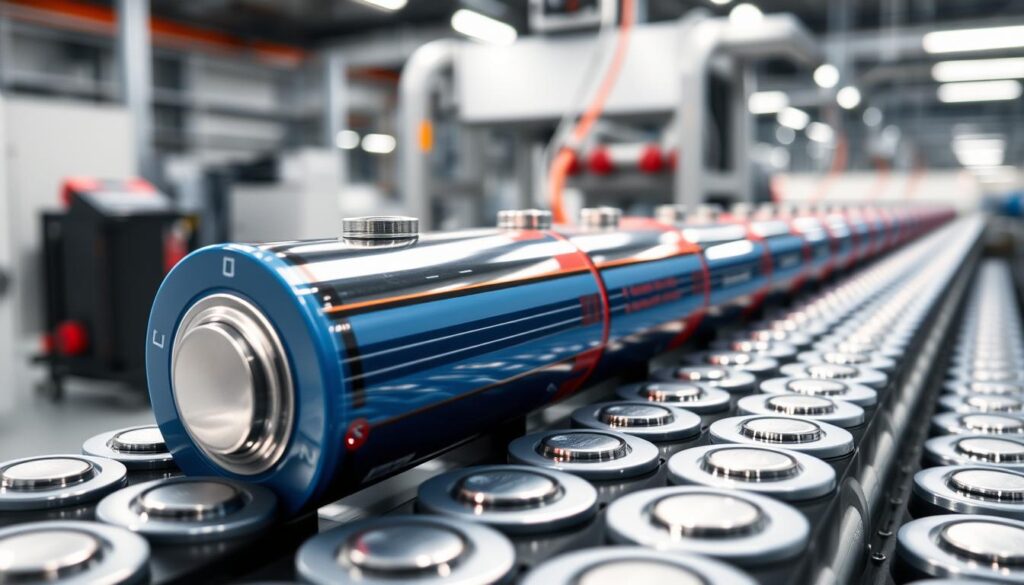
The electric vehicle (EV) industry is growing fast, thanks to better battery tech. Many types of batteries power EVs, each with its own strengths. Let’s look at the most common EV batteries and new ones that are changing the game.
Lithium-Ion Batteries
Lithium-ion batteries lead the EV market. They pack a lot of energy, last long, and perform well. The main types are nickel-manganese-cobalt (NMC) and lithium iron phosphate. NMC batteries have high energy, while LFP batteries are safer and cheaper.
Car makers are working to make lithium-ion batteries even better. They want to boost energy, speed up charging, and improve performance.
Most EVs and PHEVs use lithium-ion batteries. Their capacity ranges from 20 kWh to 100 kWh, giving them a long driving range. LFP batteries are cheaper because they use fewer critical minerals.
Solid-State Batteries
Solid-state batteries are a new tech. They use a solid electrolyte instead of liquid or gel. This makes them safer, more energy-dense, and faster to charge.
Many companies are investing in solid-state batteries. They aim to make them available soon. These batteries could cut EV battery carbon footprint by nearly 40% and offer over 500 miles on a single charge. BMW and Ford are testing them for 2025 cars.
“Solid-state batteries are expected to be introduced in 2030 and are characterized by greater stability and energy density despite being very expensive at the moment.”
Emerging Alternatives
While lithium-ion batteries are common, new options are being explored. These alternatives aim to overcome lithium-ion’s limitations:
- Sodium-ion batteries: They could be a cheap alternative, thanks to sodium’s abundance.
- Lithium-sulfur batteries: They promise more energy and lower cost than lithium-ion.
- Metal-air batteries: Lithium-air and zinc-air batteries could offer high energy density.
- Flow batteries: They store energy in liquid and are considered for stationary use.
Other batteries, like nickel-metal hydride (NiMH) and lead-acid, also have roles in EVs. NiMH batteries last longer and are used in HEVs. Lead-acid batteries are cheap and safe but have low energy and poor cold-weather performance.
As EVs evolve, better batteries will be key. New chemistries, cell designs, and making processes are being developed. They aim to make EVs more efficient and affordable.
Supply Chain and Raw Materials
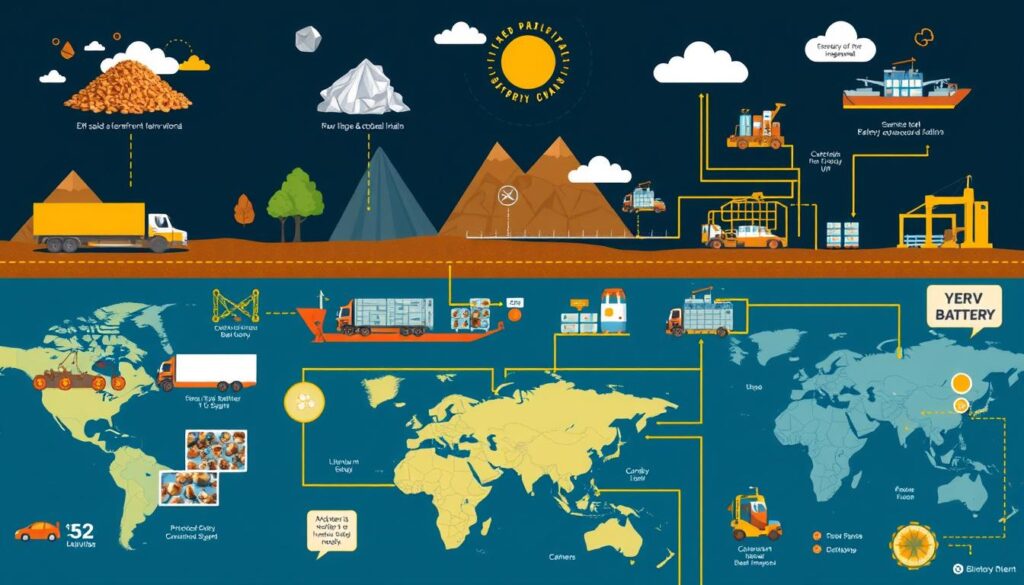
The demand for electric vehicles (EVs) is growing fast. This puts a lot of pressure on the supply chain for key minerals like lithium, cobalt, nickel, and graphite. It’s important to have a steady supply of these materials for the EV industry to grow sustainably.
Sourcing Critical Minerals
China leads the world in processing battery raw materials. In 2022, it processed 65% of the world’s lithium and 74% of cobalt. Other countries like Australia, Chile, and China for lithium, and the Democratic Republic of Congo for cobalt, have a lot of these minerals. This creates risks and can cause supply chain problems.
To avoid relying too much on one country, countries and companies are looking into new mining projects. They’re also forming partnerships and investing in recycling. The U.S. and the European Union are working to build their own EV battery supply chains. They want to make sure they have a steady supply of materials.
Challenges in Supply Chain Logistics
The EV battery supply chain has many challenges. The COVID-19 pandemic showed how vulnerable global supply chains are. It caused factory closures and delays in production.
There’s also a problem with transportation. The infrastructure and shipping capacity are limited. This makes it hard to move battery parts and finished products efficiently.
| Region | Lithium-ion Battery Manufacturing Capacity (May 2023) |
|---|---|
| China | 73.3% |
| United States | 6.7% |
| Germany | 5.4% |
| Poland | 3.2% |
Trade policies, tariffs, and regulations affect the EV battery supply chain. Automakers are trying to build strong relationships in the supply chain. They want to make sure they have a steady supply of materials.
Recycling and Sustainability Efforts
As the EV battery market grows, recycling becomes more important. Recycling helps reduce the environmental impact of battery production. It also provides a second chance for raw materials.
Once electric vehicle batteries reach their end of life, they can be recycled, and materials can be reused in new EV batteries.
Governments are setting rules and offering incentives for recycling. The EU’s Gigabat project aims to increase Europe’s battery production. It wants to make sure production is sustainable and responsible.
Regional Insights and Market Dynamics

The electric vehicle (EV) battery market is growing fast worldwide. In 2022, it was worth USD 44.69 billion. It’s expected to grow by 21.1% each year until 2030.
Automotive lithium-ion batteries are key, making up over 66% of the market in 2022. Their demand is set to jump by 65%, from 330 GWh in 2021 to 550 GWh in 2022.
North America
The US EV battery market is booming. This is thanks to government support and incentives. The Tesla Gigafactory in Nevada has been a big help.
The Infrastructure Investment and Jobs Act will also help the EV battery supply chain in the US.
Europe
Europe aims to lead in EV adoption. It’s pushing for more local EV battery production. The European Battery Alliance was started in 2017 to make this happen.
Europe’s strict CO2 standards and incentives are also boosting EV growth.
Asia-Pacific
Asia-Pacific, led by China, South Korea, and Japan, is the biggest player in EV battery production. In 2022, it made up over 51% of the global revenue. China dominates with CATL and BYD leading the way.
South Korea’s LG Chem and SK Innovation, and Japan’s Panasonic, are also key players.
| Region | Market Share (2022) | Key Players |
|---|---|---|
| Asia-Pacific | 51.0% | CATL, BYD, LG Chem, SK Innovation, Panasonic |
| Europe | 25.0% | Northvolt, LG Chem, CATL |
| North America | 20.0% | Tesla, Panasonic, LG Chem |
The EV battery market is set to keep growing fast. Electric car sales hit over 10 million in 2022. In the first quarter of 2023, over 2.3 million electric cars were sold.
As EV demand rises, so will the need for better battery tech and manufacturing. This will drive growth in the EV battery industry worldwide.
Future Outlook and Innovations
The EV battery manufacturing industry is on the verge of a big change. Technological advancements and new ideas are leading the way. Next-generation batteries aim to improve energy density, fast charging, and safety.
Companies like NAWA Technologies are working on ultra-fast carbon electrodes. These could boost battery power tenfold. SVOLT’s cobalt-free batteries have higher energy density. They could enable a range of up to 500 miles on a single charge.
Technological Breakthroughs
Researchers are looking into new ways to improve EV batteries. Solid-state batteries are becoming popular because they’re safer and charge faster. Toyota’s solid-state battery can charge in just seven minutes.
Companies like Solid Power Inc. and QuantumScape are working on solid-state batteries for EVs by 2026. Silnano’s sand-based battery technology could boost performance by 40%. StoreDot’s biological charger can recharge EVs in five minutes.
Policy and Regulatory Landscape
Governments are setting policies to support EV battery growth. They aim for carbon neutrality and EV adoption. Regulations and standards are being put in place for responsible sourcing and production.
China has assigned EV battery traceability and recycling to manufacturers. This shows the changing regulatory scene.
Investment and Market Dynamics
The EV battery industry is seeing a lot of investment. Venture capital firms, automakers, and governments are all in. Strategic partnerships and mergers are common to stay ahead.
Investment in R&D is key for better battery technologies. High-nickel cathodes and silicon anodes can improve performance. The industry is preparing for the growing demand for sustainable batteries.
FAQ
What are the key drivers of growth in the EV battery manufacturing industry?
The growth of EV battery manufacturing is driven by several factors. Demand for electric vehicles is rising. Governments are offering support and incentives. The cost of lithium-ion batteries is falling. Advances in battery technology are also playing a key role.
Who are the major players in the EV battery manufacturing industry?
Major players include Contemporary Amperex Technology Co. Limited (CATL), LG Chem, Panasonic, Samsung SDI, and SK Innovation. These companies are working closely with car makers. They are also expanding their production.
What types of batteries are used in electric vehicles?
Electric vehicles mainly use lithium-ion batteries. This includes NMC and LFP chemistries. Solid-state batteries and other new types like sodium-ion and metal-air are being developed for the future.
What are the challenges faced by the EV battery supply chain?
The EV battery supply chain faces several challenges. It struggles with the availability of minerals like lithium and cobalt. Geopolitical risks and supply chain disruptions are also issues. Sustainable practices and responsible sourcing are needed.
What are the key regions driving the growth of the EV battery manufacturing industry?
Asia-Pacific, led by China, South Korea, and Japan, is leading the growth. Europe and North America are also growing fast. This is due to government support and investments in battery production.
What technological advancements are shaping the future of EV batteries?
The future of EV batteries is being shaped by several advancements. Solid-state batteries and improved lithium-ion chemistries are being developed. Advances in battery management systems and thermal management are also underway.
How are governments supporting the growth of the EV battery manufacturing industry?
Governments are supporting the industry through various policies. They are setting EV adoption targets and offering incentives. They are also investing in research and development to improve battery technology.
What role does battery recycling play in the EV battery manufacturing industry?
Battery recycling is crucial for the industry. It reduces environmental impact and provides raw materials. Companies are investing in recycling and establishing collection networks to promote sustainability.
What are the investment trends in the EV battery manufacturing industry?
The industry is attracting a lot of investment. Venture capital firms, private equity investors, and automakers are investing. Strategic partnerships and funding for research and development are becoming more common.
How is the EV battery manufacturing industry addressing the need for sustainable practices?
The industry is focusing on sustainable practices. It is working on responsible sourcing and investing in recycling technologies. Companies are also improving the environmental footprint of battery production and developing sustainable chemistries.